How effective is government-led conservation of this iconic species?
This is the question I set out to investigate in September of 2025. Over eight months, I wrote ~250 pages (including Appendices and References) concluding that legislative boreal caribou protections in Alberta and Ontario are highly ineffective. The process was incredibly rewarding, and presented many interesting findings about measuring conservation success, conserving highly mobile animals in areas of desirable natural resources, and the limitations of politicized conservation.
Why should we care about boreal caribou?

Canada technically has three subspecies of caribou, two of which have multiple populations: Peary caribou, barren-ground caribou (Dolphin and Union populations), and woodland caribou (boreal and southern mountain populations). Boreal caribou are the boreal population of woodland caribou, and have the broadest distribution of all subspecies at 51 ranges across the Yukon, Northwest Territories, British Columbia, Alberta, Saskatchewan, Manitoba, Ontario, Quebec, and Newfoundland and Labrador.
Due to their biological needs, boreal caribou are considered umbrella and indicator species. This means that their habitat requirements – long, undisturbed, mature boreal forests – align with those of many other species. Similarly, their wellbeing indicates the health of surrounding boreal ecosystems. The ecological importance of boreal caribou is matched by their immense social value for Indigenous Peoples’ harvesting, knowledge, and familial systems as well as broader Canadian culture. Unfortunately, boreal caribou have been listed as threatened federally since 2003, in Alberta since 1985 and in Ontario since 2007. Due to their need for large undisturbed habitats, they are very sensitive to landscape fragmentation – particularly caused by natural resource development and extraction. These alterations in habitat cause what is known as apparent competition, in which disturbed boreal ecosystems support increasing predator populations.
Alberta and Ontario were selected as they both house extensive natural resource industries, and have both garnered notable media attention from legal, environmental, and civil society entities regarding their boreal caribou conservation. Alberta’s woodland caribou are some of the most highly threatened in Canada, none of their ranges have been deemed suitable to meet boreal caribou needs. Ontario’s ranges are much less fragmented, however population trends are declining and habitat trends are largely unknown. Both provincial governments are also known for their reckless extraction mandates which either neglect or override environmental protections. In this context, my thesis asked:
Is Canada’s legislative, regulatory, and policy-based biodiversity conservation regime effectively protecting and recovering boreal caribou in Alberta and Ontario?
How does one measure the success of conservation policy?
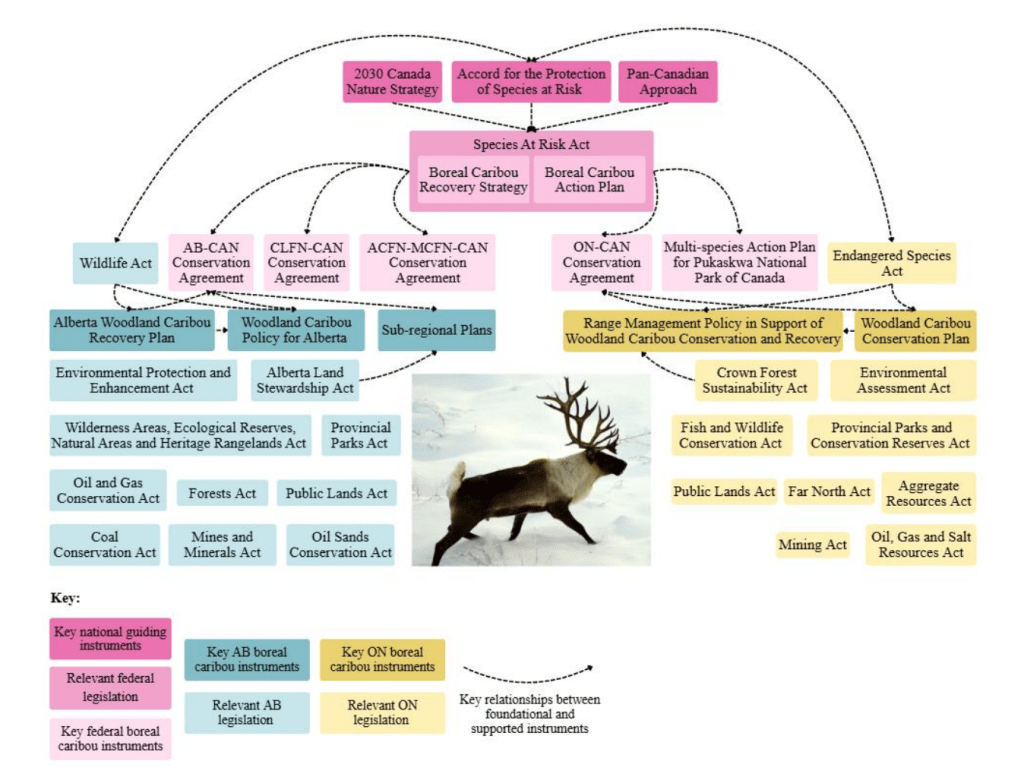
Measuring the “effectiveness” of conservation policy was way more complex than I realized. On the surface it seems a simple question of if laws and policies result in positive or negative trends for he species of focus, right? Wrong. In fact, the definition of successful biological conservation has long been that subject of debate between experts. Species, especially boreal caribou, exist within a matrix of highly dynamic, complicated ecological, social, political, and economic factors. For example, a key boreal caribou mechanism used by Alberta is the culling (i.e., mass killing) of wolves, which is effective but has many ecological and ethical implications. Additionally, the key habitat disturbances for caribou in both provinces are industries central to provincial and national economies, i.e., oil and gas, mining, forestry. So, measuring the success of conservation policies requires an understanding and consideration of the dynamic socioecological systems in which such policy is nested.
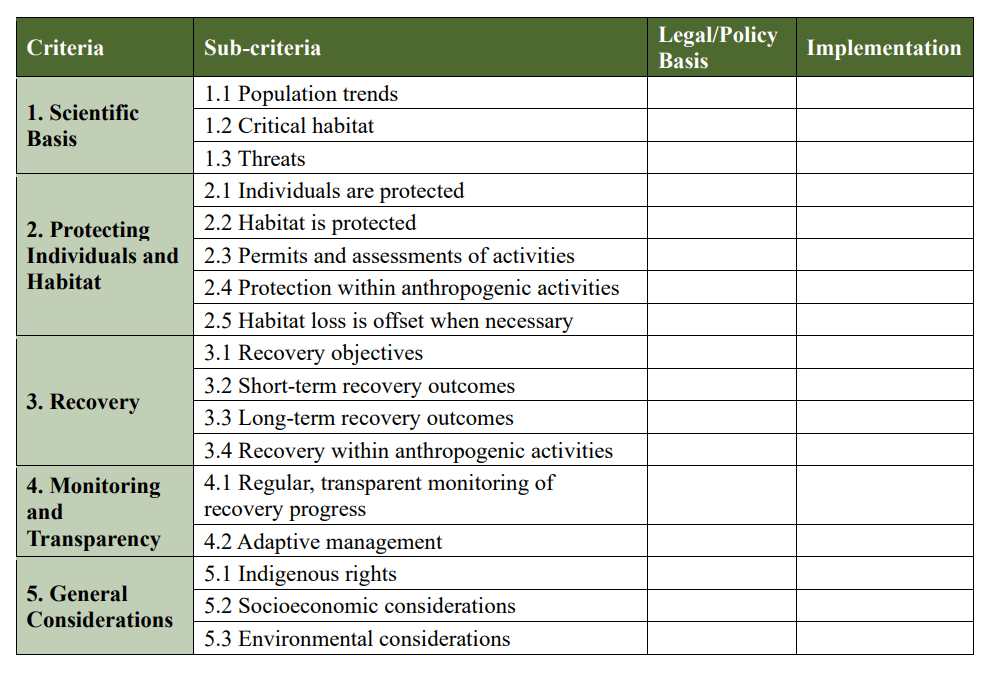
That being said, my thesis approached analysis with the belief that extirpation of boreal caribou is not an option. Thus, competing land uses and priorities were considered but the optimal result of conservation policy was conceptualized as positive impacts for species at risk and their habitats. With this in mind, and based on a wide-scoping review of literature, policy, and other media, alongside interviews with 14 key experts, I created and applied the following framework to the boreal caribou conservation regimes in Alberta and Ontario:
Results
I made five key findings regarding the federal and provincial boreal caribou conservation regimes in Alberta and Ontario, summarized below:
(1) Boreal caribou conservation regimes are impeded by a lack of tangible implementation progress that is highly disproportionate to an abundance of policies and planning: Despite decades of planning, collaboration, and research, on-the-ground progress for boreal caribou in Alberta is comprised of habitat restoration and wolf culling which pale in comparison to industry expansion within ranges while Ontario’s tangible progress is essentially non-existent. It should be noted that the boreal caribou regime has been subject to an immense amount of funding and collaboration between governments, industries, academics, Indigenous rightsholders, and NGO groups. These are successes in and of themselves, especially in the context of limited resources for other species at risk. However, it is a shame that such progress has not translated for boreal caribou.
No, I am done with plans. I am done with talking. I am done with sitting at tables … you know, the first table I sat on was in 2001. It is now 2026. OK, so the time of talking is over. We know what needs to happen. We just need people to commit to it now. Let’s start. Start protecting habitat and giving it a shot and we can do it in five year increments and reevaluate and see what works and what doesn’t. And let’s make sure we have monitoring as well. But this whole idea that we’re just going to continue to log the habitat, put roads in the habitat, mine the and then somehow hope and pray that caribou recover is ridiculous (Participant eNGO_5).
(2) The federal government has fallen short on holding Alberta and Ontario accountable to their legal commitments, instead signing conservation agreements which have not made sufficient progress for boreal caribou: Under the Accord for the Protection of Species at Risk, federal and subnational governments committed to protecting and recovering species at risk through their own legislation, policies, and programs. Canada’s Species At Risk Act (SARA) has provisions for compelling provinces to uphold their responsibilities and fill jurisdictional gaps which arise due to the constitution, in which provinces are responsible for the majority of lands and natural resources. My findings illustrate that the federal government has cause for triggering such provisions under SARA for the boreal caribou ranges in Alberta and Ontario that are in dire conditions, on the brink of extirpation, and/or are not subject to effective habitat protections. These would enforce federal protections on such ranges, and have been advocated for by numerous environmental, scientific, Indigenous, and civil society groups. However, to preserve federal-provincial relationships, conservation agreements were signed instead which have expired or are about to expire, and did/do not provide protections like what would have been achieved by provincial laws equivalent to SARA or section 61 order.
And I know that the provincial [conservation agreements] are just nothing. Again, they’re basically merely a way to ensure cooperative relationships and sometimes the, well, I guess in each case the flow of money to try to basically buy cooperation in recalcitrant provinces (Participant eNGO_1).
(3) Alberta and Ontario are highly favouring their responsibilities to natural resource development governance over those to conserve boreal caribou, resulting in the continual degradation of ranges and investments in ineffective conservation measures: Technically, the governments of Alberta and Ontario should be responsible for implementing proactive boreal caribou protection and effective recovery so that federal interventions are not necessary. However, provinces are simultaneously responsible for natural resource development and economic growth. In spite of laws, policies, and plans seeking to incorporate considerations for caribou into the governance of natural resources, boreal caribou continuously lose in the pursuit of ‘balance’ on the landscape. The current status of boreal caribou in Alberta is the result of a legacy of this fallacy. In Ontario, the northern, continuous nature of ranges have shielded them from such fragmentation, however warming temperatures and current trends in natural resource governance put them on a similar path as Alberta’s ranges.
…then a few decades later you go like, oh, we need balance. Now that you have 50% left of caribou habitat, well, caribou gets 25% industry gets 25 and then a few decades later, a few years later, did the same thing, more balance. But Caribou always loses in this balance (Participant eNGO_6).
(4) Federal and provincial governments are faced with highly complex trade-offs and conflicting priorities when attempting to conserve boreal caribou, as it is an inherently political and values-based Wicked Problem: Nearly all interview participants underlined that decision making for boreal caribou is an issue of values, particularly concerning the prioritization of extractive versus conservation land uses, as well as the numerous social, economic, political, and environmental factors influencing how these are valued. For example, participant Federal_1 explained how the conservation regime may be influenced by democratic processes and geopolitical tensions:
…you need to look at, for example, the tariffs and the impact on the socioeconomic aspects in Canada, right? So yes, you may want to protect Caribou. But you need to protect jobs in the regions you need to protect the economic engines in the regions and right now with what’s going on in the US that … gives [provinces and territories] some second thoughts about how they want to conduct the [boreal caribou] file in this specific context (Participant Federal_1).
(5) Further research and resources are required to uplift Indigenous peoples within boreal caribou conservation, as the loss of boreal caribou threatens their treaty and constitutional rights: Boreal caribou, and the boreal landscape in general, hold critical importance for the wellbeing and sovereignty of Indigenous peoples. This study did not have the scope to conduct an equitable, collaborative, and comprehensive investigation into the implications of the boreal caribou regime for Indigenous peoples. However, it did illicit findings regarding the role of Indigenous rights and leadership within the regime, as well as considerations for future research or conservation efforts. The federal and provincial regimes acknowledge the role of Indigenous rights, knowledge, and wellbeing within boreal caribou conservation. However continual disturbance of boreal caribou habitat, population declines, and inadequate consultation or collaboration within planning – especially in Alberta – is a violation of Indigenous treaty and constitutional rights. Interview participants who had experience working with Indigenous peoples discussed that the current treatment of Indigenous peoples within the regime was highly insufficient.
The provinces haven’t caught up [with Indigenous collaboration in conservation] … especially Ontario. Look, Ontario doesn’t recognize Indigenous Protected and Conservation Areas … They’re not coming to the table. They’re not speaking with those nations. They’re not looking at co-governance initiatives. They’re just like totally regressive (Participant eNGO_1).
The majority of interview respondents mentioned Indigenous leadership as a potential bright spot within the future of boreal caribou conservation. Governments should be prioritizing boreal caribou conservation that is Indigenous-led, community based, and/or co-produced in alignment with UN Declaration on the Rights of Indigenous Peoples and the Truth and Reconciliation Commission’s Calls to Action, with considerations for the overall wellbeing of First Nations and/or Indigenous communities.
So if I were to look for where I see sparks of light, I would say indigenous-led conservation is an important one and that’s where we’re we might see some hope. But then we’re going to have to stand with them and help them convince these governments to do the right thing. Because again, they would be standing up against the same system I’ve just described that is set up to extract and exploit and for them to stand up and say no, no, no, these waters and these areas are so important culturally and ecologically that we need to keep them and leave them alone. That’s also going against the [grain], so we need to stand with them and so hopefully Canadians will see that … So
yeah, but I think it’s probably going to get a bit darker before it gets better, but that doesn’t mean we give up. And so I just want to flag that we don’t give up and we just keep fighting (Participant eNGO_5).
Broader relevance: Current development mandates and declining landscape connectivity
Boreal caribou embody the key challenges inhibiting federal and subnational biodiversity conservation regimes. Particularly, the lack of federal leadership associated with the constitutional authority of provinces and Canada’s continual emphasis on natural resource extraction which neglects avoidance of negative biodiversity impacts and favours ineffective mitigation measures. The case of boreal caribou further highlights that effective federal intervention remains unlikely in the context of continual provincial failures to protect habitat. This calls into question the overall strength of SARA as one of the key federal laws for biodiversity conservation.
Findings also highlight inherent linkages between natural resource legislation and biodiversity conservation regimes, particularly the implications of impact assessment laws and a lack of landscape-level cumulative disturbance approaches. Thus underlining the complications borne from dichotomous provincial responsibilities for natural resource development and biodiversity conservation. Furthermore, the boreal caribou case study demonstrates the plethora of values and priorities which make biodiversity conservation a Wicked Problem for policymakers.
Boreal caribou conservation are closely related to the topic of my graduate research – the conservation of ecological connectivity in multifunctional landscapes targeted for natural resource development. Ecological connectivity, generally, is the ability of species, propagules, gametes, or genes to move between habitats. It is critical for the conservation of diverse, abundant, healthy wildlife. Boreal caribou are highly mobile species which require low-disturbance landscapes to move between habitat. The findings of my undergraduate thesis therefore demonstrate the broader limitations for connectivity conservation in Alberta and Ontario. This is especially relevant today, with federal and provincial mandates for accelerated large-scale development and extraction. Such mandates have resulted in provisions for weakening species at risk protections, further threatening connectivity with increasing landscape fragmentation.
Read my full thesis here, and please enjoy the quote I ended it with:
Finally, it may just be that caribou are so culturally and ecologically important that they will serve not as victims but rather as arbiters of what happens to the North. Certainly no other animal has the same power is better placed to inspire change. And since caribou above all need space – and a lot of it – sorting things out for this species would have formative consequences for a huge expanse of land – everything from the boreal forest to the High Arctic Islands – which constitutes almost half the area of North America. Improbable? Beyond hope? We don’t think so; we don’t think we can afford to think so. After all, it not caribou, then what other natural element of the North will bring humanity to its senses? (Hummel & Ray, 2008, pg. 25)


Leave a Reply