I have not yet finished The Sacred Balance, and actually have another blog post in draft about my most recent read (Is a River Alive? by Robert Macfarlane). However when Earth Overshoot Day occurred last week, I thought it was the perfect embodiment of why more people should read David Suzuki’s The Sacred Balance.
What is Earth Overshoot Day?
On June 30th, the human race officially extracted more than the Earth can regenerate in a year. This is known as Overshoot Day, in which “overshoot” is calculated by comparing ecological footprint data to what is known about Earth’s biocapacity. Although the science is always being updated, this Day allows us to quantify what has been widely known for decades – we are using our planet exponentially past its limits.
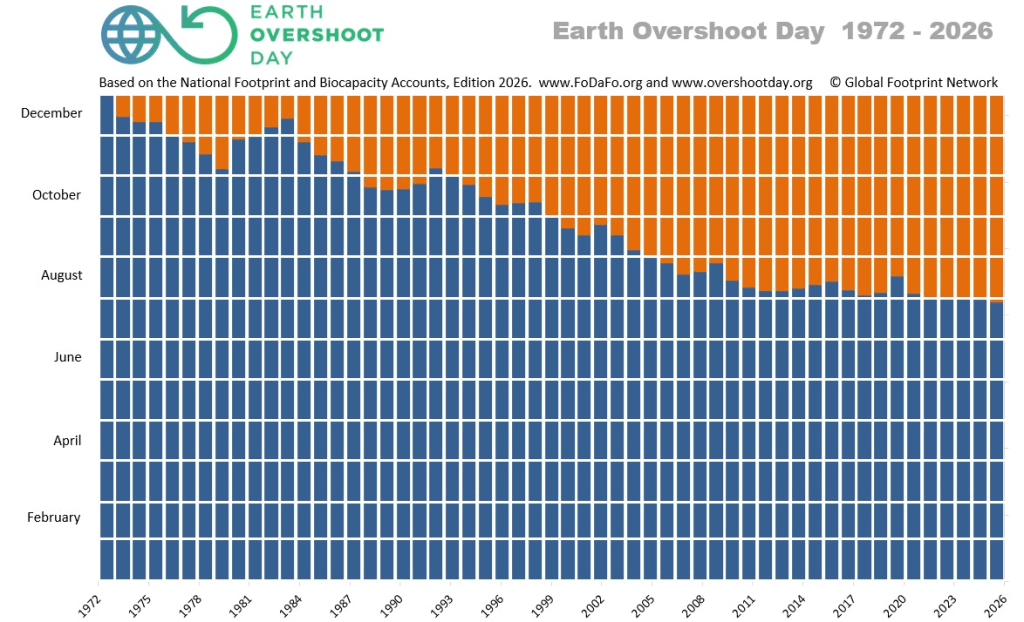
According to the experts behind Earth Overshoot Day, overshoot began and accelerated by five months between 1972 and 2026 (below). In the context of 300,000 years of Homo sapiens‘ existence, this demonstrates why many refer to our current geological epoch as the Anthropocene. This differentiates from the Holocene (which began 11,700 years ago) as it captures a period in which human dominance has more influence on the planet’s climates and ecosystems than any other natural process. It is argued that the Anthropocene began in the year 1950, and has exponentially worsened over decades.
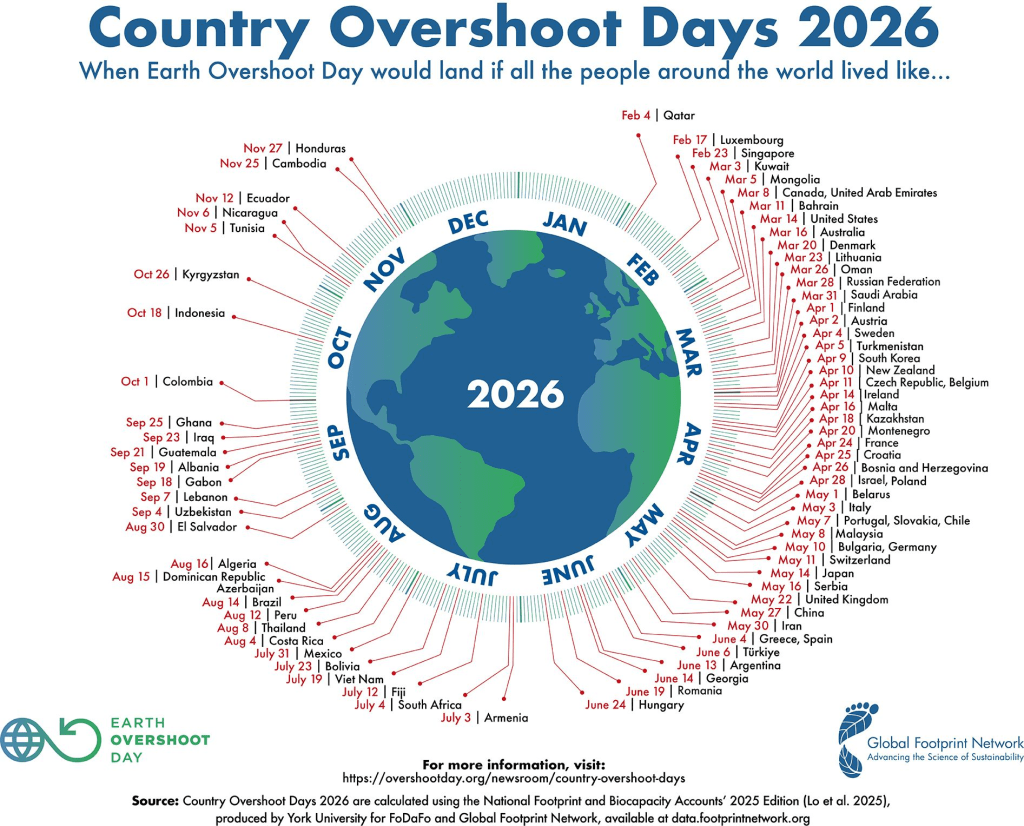
The figure below demonstrates the extremely unequal distribution of international responsibility for overshoot, in which the most developed countries have had the privilege to extract and pollute at global detriment. International agreements on climate change and biodiversity loss have sought to address this inequality, underlining that a country’s contribution to remediating such crises should align with their part in causing them. However, we continuously see the most privileged countries, corporations, and individuals benefiting from exploitation of planet and people. Canada is one of the world’s worst perpetrators, on par with the United Arab Emirates (below). If everyone on this planet lived like our country, we would hit overshoot a mere two months and eight days into the year. Despite our abundant wilderness and biodiversity, we remain an inherently unsustainable country.
I feel as though the word “sustainable” has lost its meaning, it is so often used as a buzzword for entities that are anything but. When Overshoot Day tells us we are decimating Earth’s abilities to sustain humankind, it is demonstrating that we are literally the makers of our own destruction. These abilities to sustain are because of billions of natural miracles happening every day, and it is one of the biggest heartbreaks in Earth’s history that these miracles have been misunderstood and therefore mistreated – to our extreme detriment. For those worried about overshoot, I believe that the first step is understanding the natural balance that we have strayed so far from.
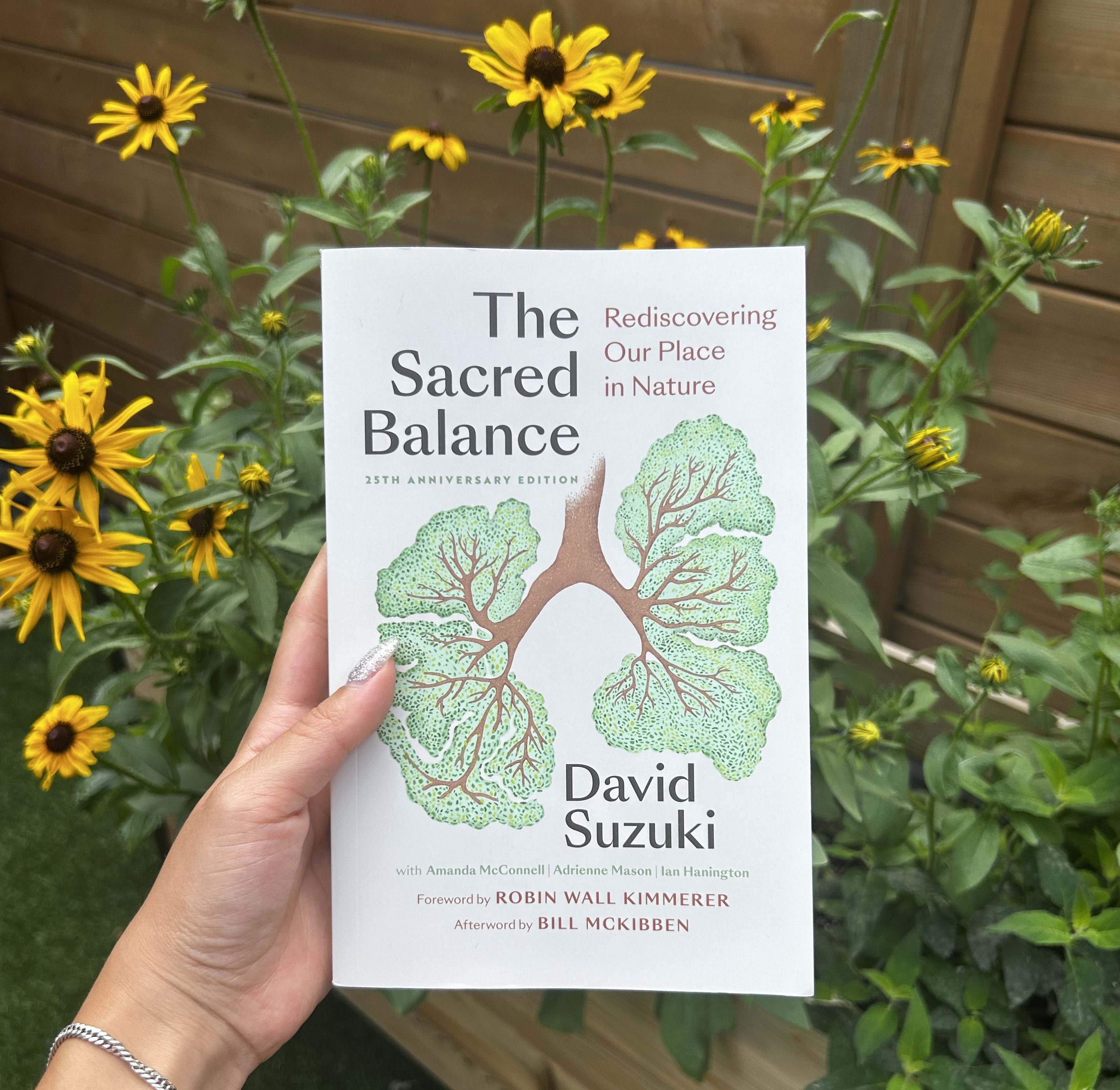
The Sacred Balance
I am a firm believer that learning incites action. Learning opens your worldview, and reminds you are part of a world in which every being is connected. This perspective is one you have to work on, as it goes against the mainstream value systems ingrained in how we see the world around us. The Sacred Balance explains these connections in actionable ways, acting as a beginner’s guide to society’s misalignment with natural systems, processes, and functions. You will learn to appreciate delicacy of the air we breathe, the water we use, the soil we stand on, and so many more processes that go unseen, unnoticed, and misunderstood.
The Sacred Balance was originally published in 1997. The version I am reading is the updated 25th anniversary edition, with a foreword by Robin Wall Kimmerer, afterword by Bill McKibben, and updated statistics and case studies. This book is a 340-page comprehensive introduction to the key earthly components upholding society – air, water, soil, fire, systems of reproduction and death, relationships, and more. There is a particular emphasis on how humans have been part of these systems since our creation, rather than separate from them. Using illustrative and digestible writing, insights from western and Indigenous knowledge systems, and intriguing real-world cases, The Sacred Balance is the perfect intro to how humans are embedded in complex biological systems.
Since this book is pretty science forward, I would recommend pairing it with a fiction if you are not a regular non-fiction reader. The way it is structured, taking time between chapters is totally okay! I myself have been reading it in addition to a fiction and additional non-fiction, and look forward to returning to it every time. I would also recommend that you explore Power of Possibility Platform created by those behind Earth Overshoot Day, it highlights interventions for remediating overshoot which are both within our grasp and already being implemented around the world.


Leave a Reply