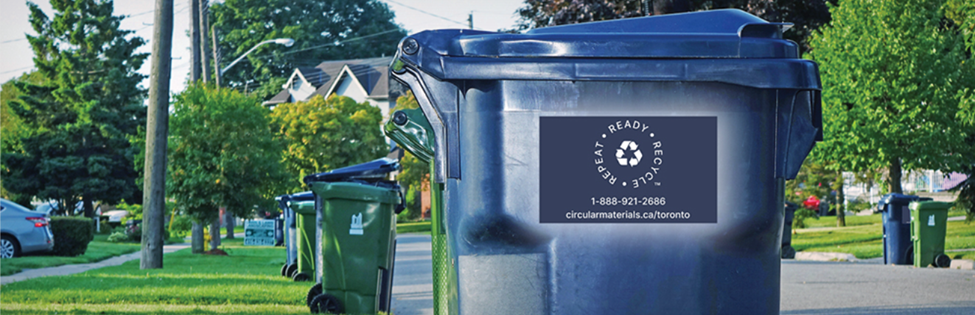
Toronto has a new blue bin program coming in 2026. Beginning January 1st, the City will no longer be collecting recycling from single-family homes, multi-residential buildings, long-term care homes, or schools. These will instead be collected and managed by Circular Materials, a third-party recycling company.
Precedent for the change, according to the City, is Ontario Regulation 391/21 (O.Reg. 391/21: BLUE BOX) under the Resource Recovery and Circular Economy Act, 2016. This mandates that producers of blue box materials are fully financially and operationally responsible for providing recycling services to residential locations, schools, long-term care and retirement homes. The regulation thus implements Extended Producer Responsibility (EPR), which places responsibility on a producer for the entire life cycle of their products – from creation to disposal. EPR is a core tenant of a circular economy, as it incentivizes waste reduction and sustainable waste management by making producers responsible for the entire impact of their products.
Changes to come
The City will remain responsible for blue bin materials from commercial locations, city divisions and agencies, charities, institutions, and religious organizations. According to the City, the main change affecting residents is that they will have to contact Circular Materials for help with bins (e.g., missed collection, bin replacement, etc.) rather than the City. Starting this May 2025, stickers will be applied to Blue Bins at the impacted locations with information about Circular Materials (see image above). No other changes seem to be incoming.
Who is Circular Materials?
Circular Materials is the current administrator of Ontario’s common collection system. On their website, they describe themselves as “a national not-for-profit producer responsibility organization that helps producers meet their obligations under extended producer responsibility regulations across Canada”. Circular materials was founded by 17 of Canada’s largest food, beverage, and consumer product companies. Including: Costco, Kraft Heinz, Keurig Dr. Pepper Canada, Lassonde, Loblaw Companies Limited, Maple Leaf, MacDonalds Canada, Metro, Coca-Cola Canada, Nestle, PepsiCo Canada, Restaurant Brands International, The Clorox Company, Empire Company Limited, P&G, Coca-Cola Bottling Limited, Recipe. Circular Materials is also marketed as “producer-led and governed”. With their Board of Directors comprised of representatives of large scale food and beverage corporations.
Although integrating EPR and circularity into Toronto’s recycling operations seem like a promising step towards urban sustainability, a quick look into Circular Materials may point towards other priorities. The fact that it was founded by huge, corporate, “Big Food” giants that – by nature – put profits over societal benefit does not bode well for Circular Material’s motivations. Additionally, it seems that Circular Materials is on its way to gaining a complete monopoly on recycling materials in Canada. Having gained contracts for recycling in the Yukon Territory, British Columbia, Alberta, Saskatchewan, Manitoba, Ontario, Quebec, New Brunswick, and Nova Scotia. A monopoly on waste management is actually harmful to the notion of EPR, as it results in lack of incentive to innovate and optimize processes. Competition is better in the long run as it pushes companies to seek out better outcomes.
It would be nice to see a diversification of third-party EPR companies across Canada who were founded to create positive environmental impact. Rather, Circular Materials’ Board makes it pretty clear what kind of priorities they are built to serve. In my opinion, a company with that type of governance will only contribute to sustainability as is advantageous to producers and their profits. Personally, I am very interested in investigating the actual statistics of Circular Materials’ positive impacts regarding landfill diversion and material reuse.
References
Burman, D. (May 12, 2025). City of Toronto begins preparations for change in blue bin recycling program. City News. https://toronto.citynews.ca/2025/05/12/toronto-blue-bin-recycling-program-changes/
Circular Materials. (2025). About. https://www.circularmaterials.ca/about/
Circular Materials. (2025). Board of Directors. https://www.circularmaterials.ca/board/
Circular Materials. (2025). EPR in Canada. https://www.circularmaterials.ca/epr-in-canada/
City of Toronto. (2025). Changes to the Blue Bin (Recycling) Program. https://www.toronto.ca/services-payments/recycling-organics-garbage/houses/what-goes-in-my-blue-bin/changes-to-the-blue-bin-recycling-program/

 Abby Shin
Leave a comment